Get in touch
The Open-Source AI Project Challenging the Way We Understand, Analyze, and Rebuild Software.
Craft Anything: The Open-Source AI Project Challenging the Way We Understand, Analyze, and Rebuild Software
What if you could study almost any website, desktop application, mobile app, or video game, understand how it works, and build your own version using artificial intelligence? Craft Anything is an ambitious open-source project exploring exactly that possibility.
Artificial intelligence is changing software development at an incredible pace. What once required teams of experienced developers, reverse engineers, designers, and software architects can increasingly be accelerated with AI-powered tools.
But there is another side to this technological revolution that deserves more attention: Who controls the tools, the models, and the ability to understand and recreate existing technology?
While some of the world's largest AI companies are building increasingly powerful, proprietary ecosystems, open-source developers are exploring a different direction: creating independent tools that give users more control over how technology is analyzed, understood, and rebuilt.
One particularly interesting project in this space is Craft Anything, an open-source software analysis and reconstruction framework written entirely in Rust.
Its concept is straightforward but extremely ambitious: inspect existing software, collect technical evidence about how it works, and use AI coding agents to create a new implementation based on that information.
And this is where things become particularly interesting.
1. What Exactly Is Craft Anything?
Craft Anything is not simply another AI code generator.
Most AI development tools work by receiving a text prompt and generating code based on the instructions provided. They can create websites, applications, scripts, and even complex software systems, but they generally depend on the information the user supplies.
Craft Anything takes a different approach.
Instead of starting with an empty prompt, it can investigate an existing piece of software and gather information about its structure, appearance, functionality, and behavior.
You can point it toward a website, application, game, or supported software file and ask it to study what is happening.
After collecting the available evidence, it can hand the task to an AI coding agent, which builds a new project based on your requirements.
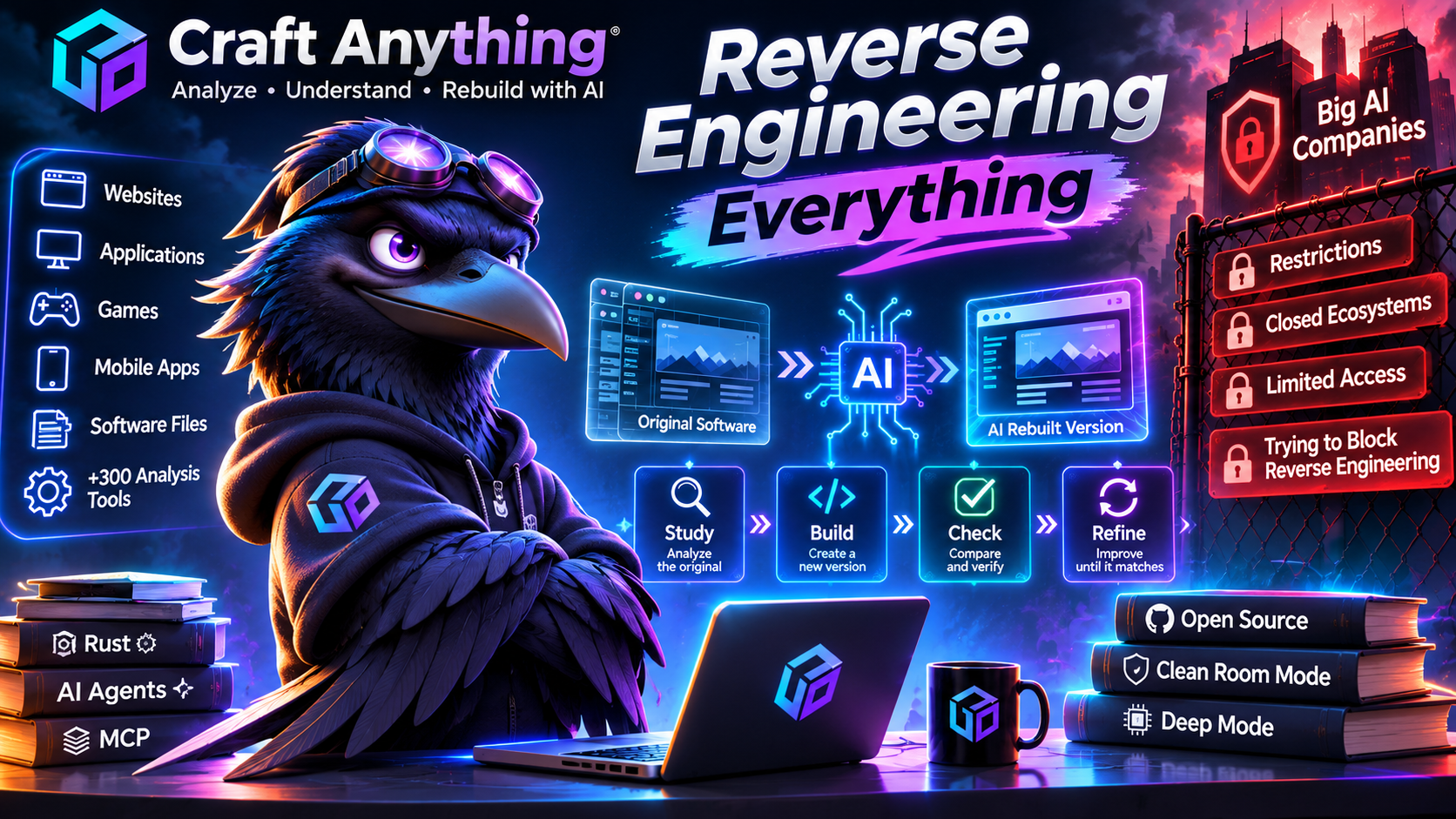
The process is organized into four main stages:
Study – Understand the Original
The first stage is about investigation.
Craft Anything provides tools for examining different types of software, including:
- Websites and web applications.
- Desktop applications.
- Mobile applications and Android software.
- Native executable programs.
- .NET and Java applications.
- Electron and JavaScript applications.
- Firmware and binary files.
- Game-related files and other technical formats.
- Databases and network packet captures.
Depending on the target and selected analysis mode, it can inspect visual layouts, application behavior, functions, dependencies, internal structures, and other technical information.
The goal is to build an evidence-based understanding of the original software rather than relying entirely on assumptions.
Build – Let AI Create Something New
Once the investigation is complete, Craft Anything can use an AI coding agent to build a new implementation.
You describe what you want, and the agent starts working on the project.
You can specify your preferred technology stack, programming language, framework, or game engine.
For example:
- Recreate a website using React.
- Build a desktop application using Rust.
- Reproduce a game's gameplay using Godot.
- Create a new interface inspired by an existing application.
- Build a similar application with different functionality or a completely different design.
The important difference is that the AI agent can work with information collected during the investigation instead of relying exclusively on a textual description.
Check – Compare the New Project
Generating code is only part of the challenge.
A website might look similar but behave differently. An application might have the right interface but lack important functionality.
Craft Anything addresses this problem by introducing a verification stage.
It compares the newly generated project with the original and identifies differences that still need attention.
Website comparisons can include three different screen widths, helping identify layout problems and visual inconsistencies.
Refine – Improve Until It Gets Closer
The final stage is continuous improvement.
The user can request modifications, and the AI coding agent can continue working on the project.
Instead of accepting the first generated result, Craft Anything creates an iterative workflow in which analysis, development, and verification work together.
This is an important step toward making AI-assisted software development more systematic and reliable.
---
2. Reverse Engineering Meets Artificial Intelligence
One of the most interesting aspects of Craft Anything is its approach to reverse engineering.
Traditionally, reverse engineering has been a specialized technical discipline requiring significant knowledge of programming languages, executable formats, assembly, operating systems, application architectures, and debugging tools.
Understanding how an existing application works can require hours, days, or even months of investigation.
Developers use tools such as disassemblers, decompilers, debuggers, binary analyzers, and specialized inspection environments to understand what happens inside software.
Craft Anything attempts to bring many of these capabilities together into a unified environment that can also be used by AI agents.
Its architecture includes hundreds of specialized tools for investigating different types of software.
The project combines its own Rust-based analysis engines with additional capabilities, including Ghidra integration when available.
This opens an interesting possibility: instead of manually investigating every component, developers can use AI agents to help navigate the analysis process, interpret evidence, identify important structures, and build new implementations.
It does not mean that reverse engineering suddenly becomes effortless or that every program can be perfectly reconstructed.
However, it can significantly change how developers approach software investigation.
The real innovation is not simply generating code with AI. It is connecting software analysis, reverse engineering, AI-assisted development, and automated verification into one workflow.
3. Clean Room and Deep Mode: Two Different Approaches
Craft Anything introduces an important distinction between two investigation methods.
Clean Room Mode
Clean Room is the default mode.
It focuses on observable behavior and deliberately avoids reading the original software's internal source code, files, or website page source.
For websites, it can use information such as:
- Screenshots.
- Visible text and interface elements.
- Colors, typography, and spacing.
- Measured layouts.
- Menus and interactions.
- Different screen sizes.
For applications, it can use visual information and window captures when permitted.
This approach is particularly interesting because it allows developers to study how software behaves from the perspective of an ordinary user.
Deep Mode
Deep Mode takes things much further.
It allows access to more detailed technical investigation, including internal code and files, using Craft Anything's analysis engines and additional tools such as Ghidra when installed.
This mode is intended for deeper technical research and private investigation.
The distinction is important because analyzing the observable behavior of an application is not the same as examining its internal implementation.
Craft Anything makes these two approaches explicit instead of treating all reverse engineering as a single operation.
---
4. The Bigger Question: Are AI Companies Building Closed Ecosystems?
There is a much larger discussion surrounding projects like Craft Anything.
Over the past few years, major artificial intelligence companies have invested billions of dollars in proprietary AI models, coding assistants, development environments, APIs, and agent ecosystems.
These technologies are becoming increasingly powerful, but many of them operate within specific commercial platforms and usage policies.
Users often depend on:
- Proprietary AI models.
- Subscription-based coding assistants.
- Restricted API access.
- Usage limits and pricing structures.
- Platform-specific integrations.
- Terms of service governing how models and tools can be used.
This creates an important question for the future of software development:
Will developers have the freedom to use AI as an independent technology, or will they increasingly depend on the ecosystems controlled by a handful of companies?
There are legitimate reasons why AI companies introduce restrictions. Security, intellectual property, privacy, abuse prevention, copyright, and protection against malicious automation are all important considerations.
However, commercial interests also matter.
Companies building proprietary AI platforms have strong incentives to retain users within their ecosystems, protect their technological advantages, and control access to certain capabilities.
This is where open-source frameworks become particularly important.
Projects that provide independent analysis engines, standardized interfaces, local execution options, and support for multiple AI agents can reduce dependence on a single provider.
It would be inaccurate to claim that all AI companies are deliberately trying to block reverse-engineering frameworks such as Craft Anything. There is no basis for treating that as an established industry-wide policy.
But there is a real tension between closed technological ecosystems and open tools that make software more accessible, inspectable, and reusable.
And this tension is likely to become increasingly relevant as AI agents become capable of performing more complex development tasks.
5. Why Reverse Engineering Could Become a Major Part of the AI Revolution
AI coding agents are already changing the way software is developed.
But generating a new application from a prompt is only one part of the equation.
Another enormous opportunity is understanding existing software.
Consider how many applications, websites, games, and development platforms already exist.
Many developers want to understand how a particular interface works, how a certain feature is implemented, or how an application behaves under different conditions.
Reverse engineering can help answer these questions.
When combined with AI, it introduces several interesting possibilities:
Software modernization: Understanding older applications and using AI to help rebuild them with modern technologies.
Legacy system analysis: Investigating undocumented software and identifying important components.
Application migration: Studying existing systems before moving functionality to a different architecture or technology stack.
Educational research: Learning how websites, applications, and software systems are structured.
Independent development: Building alternative implementations based on observable behavior and properly authorized technical investigation.
Automated software analysis: Using AI agents to navigate complex technical information and assist with repetitive investigation tasks.
The combination of reverse engineering and AI could become one of the most important areas of developer tooling in the coming years.
---
6. Built Entirely in Rust and Designed for AI Agents
Another reason Craft Anything deserves attention is its technical architecture.
The project is written in Rust, a programming language known for performance, memory safety, and its suitability for systems-level development.
According to its repository, Craft Anything includes approximately 320 tools across its engine, AI, and setup layers.
Its architecture includes three major interfaces:
- Desktop Application: A graphical environment with Simple and Advanced modes.
- CLI: A command-line interface that allows developers and automation systems to execute analysis and reconstruction tasks.
- MCP Server: An integration layer that exposes tools to compatible AI agents and applications.
The MCP integration is particularly interesting.
Model Context Protocol provides a standardized way for AI applications to interact with external tools and resources.
In Craft Anything, the tools available through the desktop application are also exposed through the CLI and MCP.
This means compatible AI agents can use the same underlying engine without requiring the user to interact with every technical component manually.
The project also supports different AI providers and coding-agent integrations.
Claude Code is its primary verified coding-agent integration, while other integrations have different levels of implementation and testing.
This architecture makes Craft Anything more than a standalone application. It is also an extensible software analysis platform that can participate in larger AI-powered development workflows.
---
7. Is Craft Anything Trying to Replace Existing AI Development Tools?
Not exactly.
Craft Anything is better understood as an additional layer that connects software investigation with AI-assisted development.
Traditional AI coding assistants focus primarily on writing and modifying code.
Reverse engineering tools focus on understanding existing software.
Craft Anything attempts to connect these two worlds.
It can investigate an existing project, provide technical evidence, coordinate an AI coding agent, compare the generated implementation, and refine the result.
That combination is what makes the project interesting.
It does not eliminate the need for developers, specialized tools, or technical expertise.
Instead, it attempts to make complex workflows more accessible and more automated.
---
8. Current Development Status and Limitations
Craft Anything is currently an early-alpha project.
This means that although the architecture and many capabilities are already implemented, some integrations and features are still being developed or tested.
According to the project's documentation:
- The desktop application, CLI, and MCP server are available.
- The Study → Build → Check → Refine workflow works for supported website, application, and game scenarios.
- Claude Code is the primary verified coding-agent integration.
- Website comparison tools are available.
- Game reconstruction supports workflows involving Unity, Unreal Engine, and Godot.
- Deep Mode supports additional analysis capabilities, including Ghidra integration.
- Some alternative coding-agent integrations and behavioral verification features are still partially implemented or awaiting broader testing.
It is also important to understand that Clean Room Mode is not an operating-system sandbox. Coding agents still operate with the permissions available to them on the user's computer.
Craft Anything should therefore be used responsibly, with appropriate authorization to examine the target software.
It does not promise perfect reconstruction of every application, and it does not bypass DRM, authentication, or anti-cheat protections.
These limitations do not make the project less interesting. They simply show that it is an ambitious technology that is still evolving.
---
9. The Future: Open-Source AI Tools and Technological Independence
The future of artificial intelligence should not be defined exclusively by the largest technology companies.
Open-source projects play an important role in keeping innovation accessible, allowing developers to experiment, build alternatives, and create technologies that are not tied to a single commercial ecosystem.
Craft Anything represents an interesting example of this philosophy.
It combines reverse engineering, software analysis, Rust, AI coding agents, CLI automation, and MCP into a single environment.
More importantly, it explores an idea that could become increasingly important:
What if AI could help us understand almost any software system, instead of simply generating new code without knowing how existing systems work?
This is a much bigger opportunity than creating another AI website builder.
It is about making software more understandable, making development workflows more accessible, and giving developers better tools to investigate and create technology.
As AI companies continue developing increasingly closed ecosystems, independent open-source frameworks will have an important role in preserving choice, interoperability, and technological freedom.
Craft Anything is still in its early stages, but its direction is worth watching.
---
Final Thoughts
Craft Anything is an ambitious open-source project that explores the intersection of artificial intelligence and reverse engineering.
Its approach is different from traditional AI coding assistants because it attempts to understand existing software before building something new.
The combination of hundreds of analysis tools, a Rust-based engine, AI coding agents, MCP integration, and automated comparison creates an interesting foundation for the next generation of software development tools.
Whether you are a software developer, reverse engineering enthusiast, AI researcher, or simply someone interested in open-source innovation, Craft Anything is a project worth exploring.
The most interesting question is not whether AI can write code.
It is how far we can go when AI can also help us understand the technology that already exists.
Technology should empower developers, not lock them into a single ecosystem. And projects like Craft Anything are exploring what that future could look like.
---
Project Links and Resources
- GitHub Repository: https://github.com/storytold/craft-anything
- Official Website: https://getartcraft.com/
- Craft Anything Downloads: https://github.com/storytold/craft-anything/releases
- Technical Documentation: https://github.com/storytold/craft-anything/tree/main/docs
- Discord Community: https://discord.gg/artcraft
Disclaimer: Craft Anything is an early-alpha project. Features, integrations, and capabilities may change as development continues. Always use reverse engineering tools only on software you own or are legally authorized to examine. Respect intellectual property, software licenses, privacy, and applicable laws.
Your email address will not be published. Required fields are marked *
Cookie preferences