Get in touch
Why AI-assisted development is not as easy as everyone thinks — and how to distinguish an experienced software engineer from someone who simply knows how to use AI.
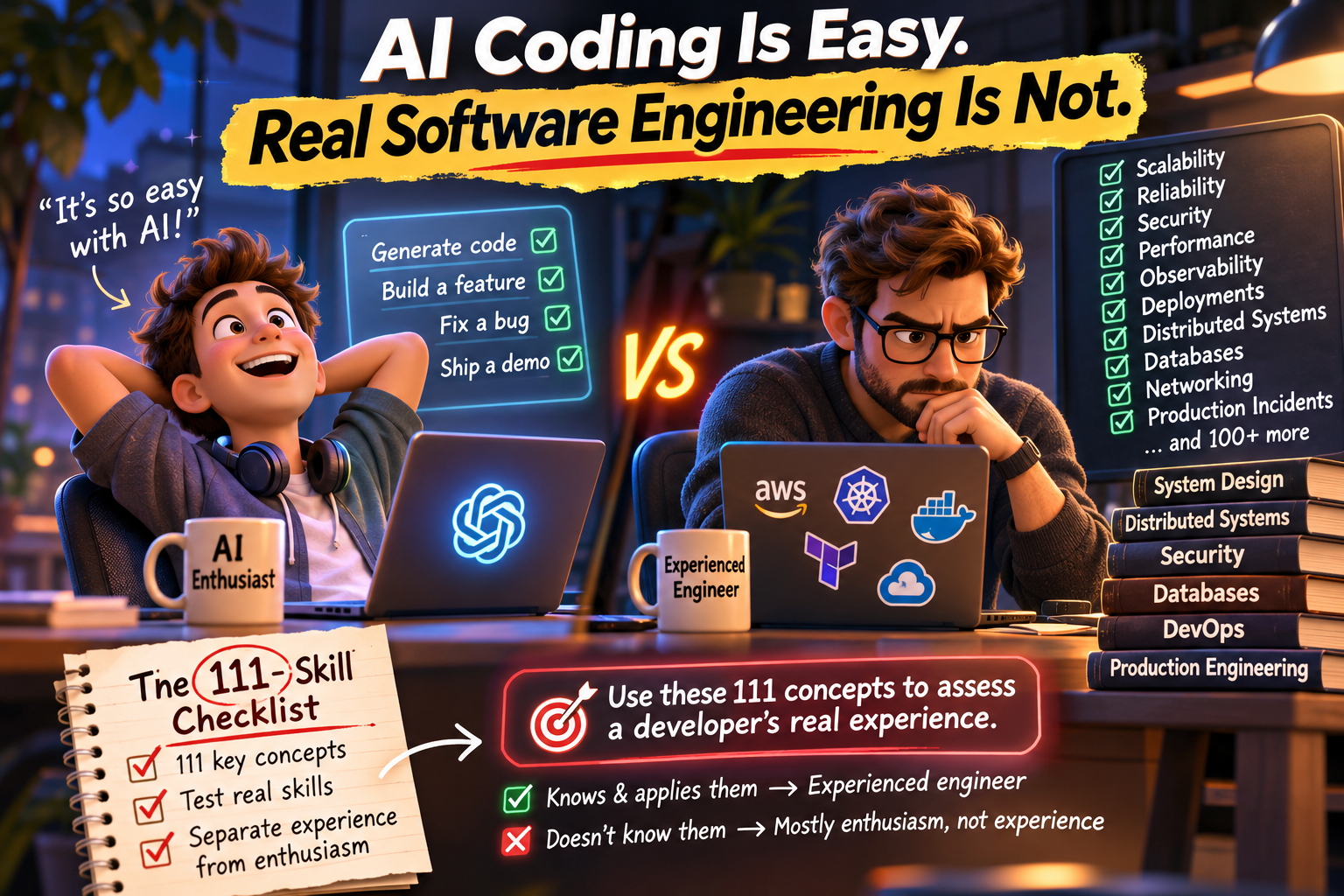
🚀 AI Coding Is Easy. Real Software Engineering Is Not.
🤖 Why AI-assisted development is NOT as easy as everyone thinks — and how to distinguish an experienced software engineer from someone who simply knows how to use AI.
Over the past few years, software development has undergone a massive transformation.
Tools like Claude, ChatGPT, Cursor, GitHub Copilot, and other AI-powered platforms have completely changed how we write software.
Today, almost anyone can open an editor, describe an application in plain English, and generate working code within minutes.
You can build an API, a dashboard, an authentication system, or even an entire application without manually writing every line of code.
But there is one major problem:
«⚠️ Being able to generate code with AI does NOT mean you know how to engineer software.»
There is a massive difference between building a prototype that works on your laptop and developing a production-ready system that is secure, scalable, reliable, and maintainable.
AI can generate code. It can suggest architectures, fix bugs, and accelerate implementation.
But what happens when your system has 100,000 concurrent users? Who understands why database queries suddenly become slow? Who investigates a production incident at 3 AM? Who knows whether the architecture generated by AI will survive real-world traffic?
🔥 That is where the difference between an AI enthusiast and an experienced software engineer becomes clear.
---
🧠 1. AI Developer vs. Software Engineer
An inexperienced developer can use AI to build something that looks impressive during a demonstration.
However, as the application grows, real engineering problems begin to appear:
- 🐌 APIs become slow.
- 🗄️ Databases struggle under heavy traffic.
- ⚡ Race conditions appear.
- 💥 Data gets lost.
- 🚨 Deployments cause downtime.
- 🔐 Authentication systems contain security vulnerabilities.
- 💸 Infrastructure costs increase unexpectedly.
- 🌐 Distributed systems behave unpredictably.
AI can suggest solutions, but someone must understand the underlying problems, validate those solutions, and take responsibility for technical decisions.
«💡 A real software engineer is not someone who can generate code. It is someone who can understand, design, test, optimize, secure, and maintain the systems they build.»
---
📚 2. The 111 Skills Every Serious AI-Assisted Developer Should Understand
The following 111 concepts represent a technical checklist for anyone claiming to be capable of building complex software systems using AI.
You do not necessarily need to be an expert in every technology. However, you should understand what each concept means, what problems it solves, and when it should be applied.
🏗️ A. Backend, Infrastructure & Architecture
1. Rate Limiting
2. Caching
3. Load Balancing
4. Reverse Proxies
5. API Gateways
6. CI/CD
7. Docker
8. Kubernetes
9. Service Discovery
10. Circuit Breakers
11. Timeouts
12. Retries
13. Exponential Backoff
14. Idempotency
15. Message Queues
16. Pub/Sub
17. Event-Driven Architecture
18. Distributed Transactions
19. Saga Pattern
🗄️ B. Databases, Concurrency & Distributed Systems
20. Dead Letter Queues
21. Cron Jobs
22. WebSockets
23. Long Polling
24. Server-Sent Events
25. Database Indexing
26. Query Optimization
27. N+1 Queries
28. Connection Pooling
29. Read Replicas
30. Sharding
31. Partitioning
32. Replication
33. Leader Election
34. CAP Theorem
35. Eventual Consistency
36. Optimistic Locking
37. Pessimistic Locking
38. Distributed Locks
39. Race Conditions
40. Deadlocks
41. Memory Leaks
⚡ C. Performance, Scaling & Deployment
42. Garbage Collection
43. Thread Safety
44. Backpressure
45. Autoscaling
46. Horizontal Scaling
47. Vertical Scaling
48. CDN
49. Edge Caching
50. Cache Invalidation
51. Feature Flags
52. Blue-Green Deployment
53. Canary Releases
54. Rolling Deployments
55. Rollbacks
56. Health Checks
57. Liveness & Readiness Probes
58. Monitoring
59. Logging
🔐 D. Observability, Security & Authentication
60. Distributed Tracing
61. Metrics
62. Alerts
63. SLOs
64. SLIs
65. Error Budgets
66. Observability
67. Secrets Management
68. IAM
69. OAuth
70. JWT Rotation
71. TLS
72. Encryption at Rest
73. Encryption in Transit
74. WAF
75. DDoS Protection
76. CORS
77. CSRF
78. SQL Injection
79. XSS
80. SSRF
81. Database Migrations
82. Schema Versioning
🌍 E. Reliability, Networking & Production Engineering
83. Disaster Recovery
84. Backups
85. Failover
86. Multi-Region Deployment
87. Chaos Engineering
88. Cost Optimization
89. Cold Starts
90. Serverless Limits
91. Latency
92. Throughput
93. P99 Latency
94. Tail Latency
95. Network Partitions
96. Clock Skew
97. DNS
98. TCP vs UDP
99. HTTP/2 & HTTP/3
100. gRPC
101. Webhooks
🛠️ F. Software Lifecycle & Engineering Practices
102. API Versioning
103. Semantic Versioning
104. Infrastructure as Code
105. Terraform
106. Helm Charts
107. Build Caching
108. Dependency Hell
109. Production Incidents
110. On-Call
111. Postmortems
---
🎯 3. Use These 111 Concepts to Test a Developer's Real Skills
This list is not just a collection of technical terms. It can also be used as a practical framework to evaluate a developer's actual engineering knowledge and experience.
If you want to determine whether someone has real software engineering experience, do not simply ask whether they know how to use Claude, Cursor, or ChatGPT.
Test them on these concepts.
For every concept, ask three questions:
1️⃣ What is it?
Can they explain the concept in their own words without reading a definition from the internet?
2️⃣ Why does it matter?
Do they understand the problem it solves and why it matters in a real-world application?
3️⃣ Have you implemented or debugged it in production?
Can they provide a concrete example from a real project, including the challenges they encountered and how they solved them?
🔥 Real-world interview questions
For example:
- ⚡ Ask how they would prevent a Race Condition in a system handling multiple concurrent requests.
- 📊 Ask how they would investigate an increase in P99 Latency.
- 💳 Ask how they would implement Idempotency for a payment API endpoint.
- 🚀 Ask how they would perform a Rollback after a failed deployment.
- 🔐 Ask how they would protect an API against SQL Injection and SSRF.
- 🌐 Ask how they would architect a system capable of handling hundreds of thousands of users.
- 🚨 Ask how they would investigate a Production Incident and write a Postmortem.
An experienced developer does not necessarily need to know every answer by heart. However, they should understand the principles, know how to find reliable information, and explain the reasoning behind their technical decisions.
⚠️ A VERY IMPORTANT DISTINCTION
If a developer claims to be capable of building complex production systems but cannot explain most of these concepts, cannot identify the problems they solve, and cannot demonstrate practical experience, you have a serious reason to question their level of expertise.
They might be an AI enthusiast.
They might be a talented beginner.
They might be someone who knows how to write excellent prompts.
But enthusiasm for AI is NOT the same as software engineering experience.
«🔥 Knowing how to prompt AI is not the same as knowing how to engineer software.»
---
🚀 4. AI Makes Developers Faster, Not Automatically Better
I do not believe AI will eliminate the need for software engineers.
However, I strongly believe it will fundamentally change what it means to be a good software engineer.
In the past, developers spent significant amounts of time writing code, configuring projects, and solving repetitive problems.
Today, AI can handle a considerable part of that work.
This means the value of a developer is no longer measured simply by how quickly they can write code.
Real engineering value comes from:
- 🏗️ System Design
- 🧩 Architectural Decisions
- 🐛 Debugging
- 🔐 Security
- ⚡ Performance Optimization
- 📈 Scalability
- 🛡️ Reliability
- 🗄️ Database Design
- 🚨 Production Engineering
- 🧠 Technical Judgment
The more code AI generates, the more important it becomes to have someone capable of verifying whether that code is actually correct.
An inexperienced developer can generate an application in a few hours.
An experienced software engineer understands whether that application will still work reliably six months after launch.
---
🧪 5. The Real Test: Can You Maintain What AI Builds?
Building an application is only the beginning.
The real test starts after deployment.
What happens when:
- 🧠 Servers suddenly start consuming too much memory?
- 🗄️ Database queries take several seconds?
- 🚨 A deployment interrupts your service?
- 🔌 An external service stops responding?
- ⚡ Two transactions attempt to modify the same data simultaneously?
- 🔓 An attacker tries to exploit a security vulnerability?
- 🌍 An entire cloud region becomes unavailable?
- 💸 Infrastructure costs increase tenfold?
- 🐛 A bug affects thousands of users?
You can always ask AI to generate a solution.
But you need to understand whether that solution is correct, whether it introduces new problems, and whether it can be maintained over time.
That is software engineering.
---
🏆 6. Stop Confusing AI Enthusiasm With Engineering Experience
AI is one of the most powerful tools ever introduced into software development.
But a powerful tool in the hands of someone without engineering experience can produce software that looks impressive, works during demonstrations, and fails in the real world.
❌ Knowing how to write prompts is not enough.
❌ Generating components, API endpoints, or entire applications is not enough.
✅ You need to understand the systems you are building.
The 111 concepts listed above provide a starting point for evaluating the technical competence of developers working with AI.
You do not need to memorize every definition. You need to understand, apply, test, and explain these concepts.
And if someone cannot explain these concepts, demonstrate practical knowledge, or discuss real engineering challenges, they should not claim to be a senior software engineer simply because they know how to use AI.
---
💥 FINAL THOUGHT
«AI can write the code. Engineering is knowing whether that code deserves to exist in production.»
The future does not belong to people who can generate the most code with AI.
It belongs to people who understand what they are building, why they are building it, and how to make it work reliably in the real world.
🚀 Don't just learn how to prompt AI. Learn how to engineer the systems AI helps you build.
---
💬 What do you think?
Can someone genuinely call themselves a Senior Software Engineer if they can generate entire applications using AI but cannot explain the architecture, scalability, security, databases, or production challenges behind them?
I'd love to hear your thoughts.
🔖 Suggested Hashtags
#SoftwareEngineering #AICoding #ClaudeAI #ChatGPT #CursorAI #VibeCoding #SystemDesign #BackendDevelopment #DevOps #SoftwareArchitecture #ArtificialIntelligence #Programming #TechLeadership #Engineering #Developers
Your email address will not be published. Required fields are marked *
Cookie preferences